

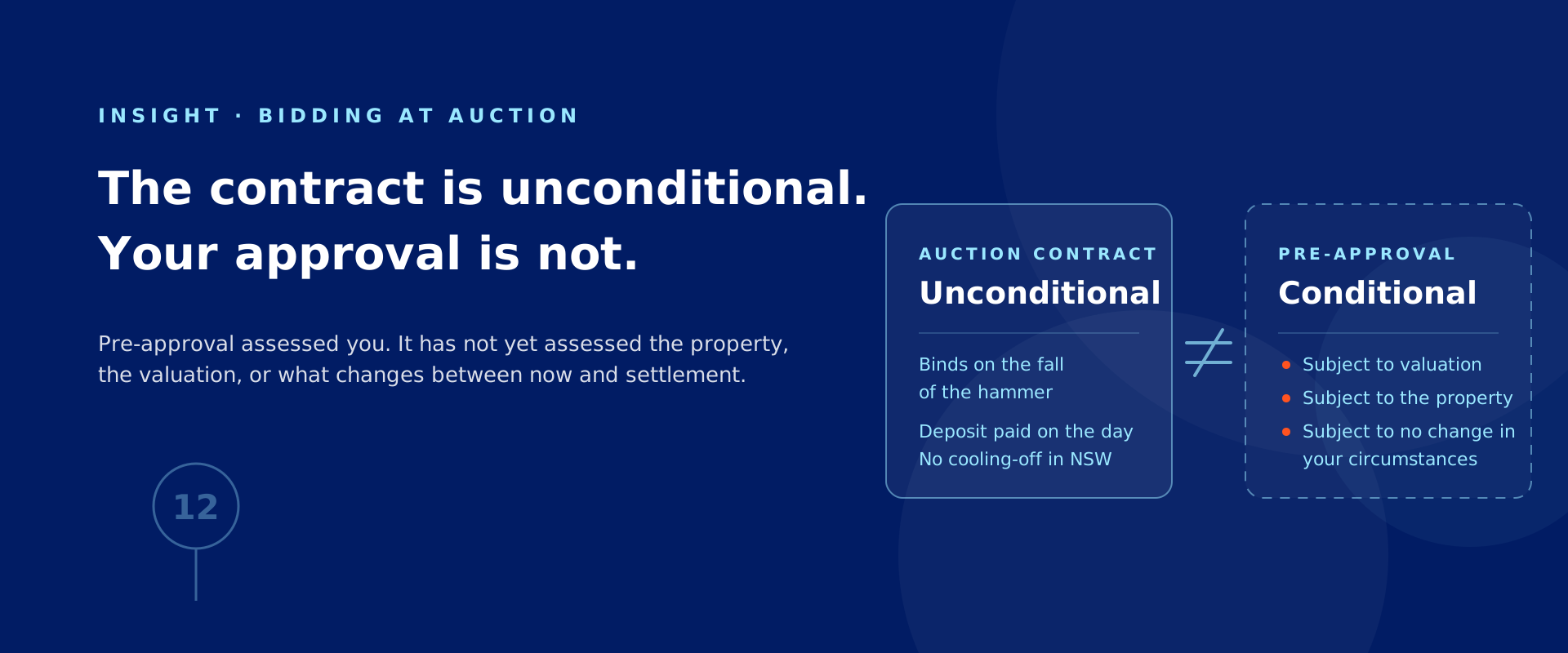
Pre-approval on its own is not enough to bid safely at auction, because pre-approval is conditional and an auction contract is not. The moment the hammer falls you are committed to the purchase, while your lender is still free to decline the loan.
Most buyers know the first half of that sentence. It is the second half, the conditions still sitting inside the approval, that catches people out.
The gap sits in the fine print of the approval letter
Every pre-approval carries conditions, usually along the lines of “subject to a satisfactory security property” and “subject to no material change in your circumstances”. In a private treaty purchase those conditions matter less, because the contract can carry a finance clause and, in NSW, a cooling-off period.
Auctions strip both protections away. There is no cooling-off period when you buy at auction in NSW, no subject-to-finance clause, and the deposit, usually ten per cent of the purchase price, is payable on the day. You have exchanged unconditionally on the strength of a conditional document.
What the lender still decides after the hammer falls
Three things remain open after you have won, and any of them can move the outcome.
The first is the property itself. Pre-approval assesses you, not the address, and lenders decline security they consider unacceptable: the size of the lot, the construction type, the postcode concentration, the title. A strong borrower attached to the wrong security is still a decline.
The second is the valuation. In the deals we work on, the practical rule is that the lender lends against the lower of the contract price and the valuation. Auction results run ahead of valuations often enough that this is the most common way the gap opens.
The third is you. The approval assumes your position on auction day matches your position at assessment. A changed job, a new car loan, a fresh credit enquiry or a reduced deposit can all reopen the assessment after you are already committed.
What a valuation shortfall looks like in dollars
Take a buyer pre-approved to borrow up to 90 per cent of a property’s value, that percentage being the loan to value ratio (LVR), who wins at auction at $920,000. They pay the $92,000 deposit on the day and plan to borrow $828,000.
The valuation comes back at $880,000. The lender will now lend 90 per cent of $880,000, which is $792,000, leaving the buyer to find another $36,000 in cash before settlement, with lenders mortgage insurance recalculated on top. These figures are an example only; the point is the mechanism, not the amounts.
What it costs when the gap is ignored
A buyer who cannot complete an auction purchase does not simply lose the property. The deposit is at risk in full, and if the vendor resells for less, the difference can be pursued as well. This is the consequence the brief for this article described plainly: if you win and cannot complete, the consequences can be serious.
Short of that worst case, the scramble itself is expensive. Buyers who find a shortfall after exchange are negotiating from the weakest position they will ever occupy: fixed deadline, committed contract, no leverage.
What auction buyers commonly overlook
None of this means auctions are only for cash buyers. It means the preparation has to match the commitment, and there are five things buyers commonly overlook.
The conditions on the letter. Pre-approvals differ widely in how much verification sits behind them. One issued from a full assessment of documents is a different instrument from one generated by a calculator, even though both say pre-approved. They also expire, commonly after around 90 days.
The valuation timing. Lenders do not value a property before auction day; their valuation happens after exchange, once it can no longer change your decision. What a buyer can do beforehand is arrange their own independent valuation, or order a desktop valuation estimate, and price that figure into the bidding limit. Neither binds the lender, but a limit set against a professional estimate is a different decision from one set against optimism.
The bidding limit itself. A limit set from a verified assessment, priced at the valuation risk, is worth more than one set from an online calculator. This matters most when you are buying your first home, because first auctions are where enthusiasm and inexperience meet.
The deposit on the day. Ten per cent in accessible funds at 6pm on a Saturday is its own problem when savings sit in term deposits or equity. Buyers whose funds are certain but not liquid sometimes buy with a deposit bond, provided the agent accepts it before bidding.
The freeze on your circumstances. Between assessment and settlement, the safest position is the boring one: same job, same debts, same deposit. The buyers who treat the approval as fragile are the ones it holds for.
The next step
If an auction campaign is in your plans, the useful work happens before the first inspection: a proper assessment, a limit you can defend, and a plan for the deposit and the valuation. That is a conversation, not a calculator. Book a Strategy Call, or call 1300 112 355. A broker in business hours; after hours a real person answers and books you in.
This information is general in nature and does not take into account your objectives, financial situation or needs. Lending criteria, rates, fees and policies vary between lenders and may change. Eligibility and approval are subject to lender assessment.
Questions buyers ask before auction day
Can the valuation be done before the auction?
Not by the lender. Lenders complete their valuation after contracts are exchanged, so the formal figure arrives only once you are already committed. What you can do beforehand is commission an independent valuation yourself, or order a desktop valuation estimate, to test the price you have in mind against something sturdier than the guide. The lender is not bound by either figure, but a large gap between your estimate and your intended bid is a warning worth having before the hammer falls, not after.
What happens to the deposit if finance falls through after an auction?
The deposit is at risk in full, because the contract is not conditional on finance. In practice the outcome depends on the contract terms and any negotiation with the vendor, but no buyer should bid assuming the deposit comes back if the loan does not complete.
Does winning at auction change the loan I was pre-approved for?
It can. The lender assesses the actual property and its valuation after exchange, and lends against the lower of the price and the valuation. If the valuation comes in under the winning bid, the maximum loan falls with it, and the difference has to come from the buyer.
