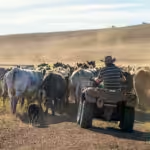
Farms & Rural Properties
Farm and rural property lending is a specialist area of finance, where acreage, land use, income profile, water, improvements, enterprise type, and property scale can all materially affect the way a deal is assessed.
Rural property finance is not just about securing a loan against land.
It is about understanding the property, the way it is used, the income attached to it where relevant, and which lenders are genuinely suited to the scenario. A lender that is comfortable with a smaller lifestyle acreage may assess a larger income-producing farm very differently.
At Evolve Lending & Finance, we help borrowers assess rural property finance options more carefully from the outset so they can make better decisions before committing to a lender.
Rural lending loan terms, interest rates and repayment options
Rural and agricultural lending can vary significantly depending on the property, borrower, farm business, loan purpose, security position and lender appetite.
Interest rates, loan terms, repayment options, application fees, fees and charges, and other terms and conditions can differ between lenders. Some facilities may suit seasonal cash flow, while others may be structured around longer-term land, livestock, equipment, infrastructure or working capital needs.
The right financial solution should match the property, the borrower and the way the farm operations actually work – not just the lowest advertised interest rate.
What farm, rural property and agribusiness loans may be used for
Finance for farms and rural properties may be relevant across a range of scenarios, including:
- farm purchases
- rural property purchases
- refinance of existing rural property debt
- lifestyle acreage in some scenarios
- income-producing rural land
- mixed-use rural holdings
- agricultural land acquisitions
- selected succession or intergenerational transfer scenarios
- seasonal cash flow and working capital needs
- farm operations, infrastructure, livestock or equipment funding
The right structure will often depend on the property size, land use, income profile, borrower strength, and whether the scenario fits lender policy.
Why rural property lending is different
Once a property moves beyond standard residential policy settings, the assessment usually becomes more specialised.
That can happen because of acreage, zoning, income-producing use, enterprise activity, water access, or the overall nature of the holding. At that point, lender fit matters much more, because not all lenders assess rural property the same way.
Two lenders can look at the same rural property transaction and reach very different outcomes based on policy, appetite, and how well the scenario is understood and presented.
What lenders usually look at
Farm and rural property lending is assessed on far more than postcode and income alone.
Lenders will usually look at:
- the size and type of the property
- whether the land is lifestyle or income-producing
- zoning and permitted use
- enterprise type where relevant
- income history and seasonality where applicable
- existing debt and repayment capacity
- available security and land value
- water, improvements, and infrastructure
- the borrower’s overall financial position
- whether the scenario fits lender policy overall
That is why rural property lending is not just about sending an application somewhere and hoping it fits.
Why structure and lender fit matter
A rural property loan can look workable on the surface and still be the wrong fit.
The lender may not suit the acreage, the zoning, the enterprise type, or the income profile. The structure may not reflect the way the property is actually used. Repayments and terms may also need to be thought through more carefully where income is variable or the property sits outside standard policy.
Good borrowers still lose time when the deal is poorly structured, poorly presented, or sent to a lender that does not suit the scenario.
That is why the goal is not simply to secure a loan. It is to choose a structure and lender that fit the property and borrower properly from the start.
For farm businesses, structure is especially important where income, expenses and cash flow vary by season, commodity cycle or operating conditions.
How Evolve helps
At Evolve Lending & Finance, we help borrowers assess farm and rural property finance options clearly before they commit.
That includes:
- reviewing the property, land use, and proposed structure
- comparing lender and product options
- identifying likely policy issues early
- helping assess repayment fit and lender suitability
- preparing the application clearly and credibly
- reducing the risk of wasted applications and poor-fit lenders
- guiding the process through to approval and settlement
The focus is not just on accessing funds. It is on helping you make a better rural property finance decision with clearer advice from the outset.
Why borrowers choose Evolve
Evolve brings a grounded understanding of rural lending and the realities that can sit behind agricultural and regional property scenarios.
Our Managing Director, Mark Stevenson, grew up in the Central West of New South Wales on a 2,000-acre family property, where his family ran a registered Shorthorn cattle stud alongside Merino and Tukidale sheep. That background gives Evolve a practical understanding of the sector, not just a theoretical one.
Speak with Evolve
If you are considering finance for a farm or rural property, it makes sense to assess the structure properly before committing to a lender.
Speak with Evolve Lending & Finance for clearer advice, better lender fit, and a more considered rural lending strategy.