

Understanding Low Doc Home Loans Benefits
Many home loans require documentation of the borrowers’ income and credit history, however there are home loans that offer borrowers with less documentation, ‘lo doc home loans’ or ‘low documentation home loans’ for short. These types of home loans can also be referred to as ‘quick approval home loans’ or ‘lo doc home loans for self-employed’, for borrowers who need home loans with less documentation and quick approval.
The feature of Low Doc Home Loans is that they offer a streamlined process of home loan approval with less documentation. Most people who look into Low Doc Home Loans are looking for a home loan that can verify their income with less traditional documentation. Many self-employed individuals can benefit from these types of home loans. Quick approval home loans often get a bad rap – but not all are created equal. Loans that specialise in providing quick approval for home loans also offer their borrowers a host of other benefits that have made low doc home loans so incredibly popular with home loan borrowers in Australia. The flexibility of the Low Doc home loans in terms of income documentation is just one reason why the loans are so well-suited to help self-employed individuals or individuals that have irregular income in order to secure home loans quickly.
Here’s a Guide to How Low Doc Home Loans Work.
Below we have outlined the main features of low doc home loans and we will outline the benefits of low doc home loans as well as the things you need to consider before choosing a loan.
What Are Low Doc Home Loans?
Low doc home loans, also known as low documentation home loans, refer to home finance products that are designed for the borrowers that do not have sufficient traditional documentation to confirm their income. These types of home loans are usually structured in a way to make approval process easier and in most cases require less documentation compared to regular home loans offered by banks and other traditional lenders.
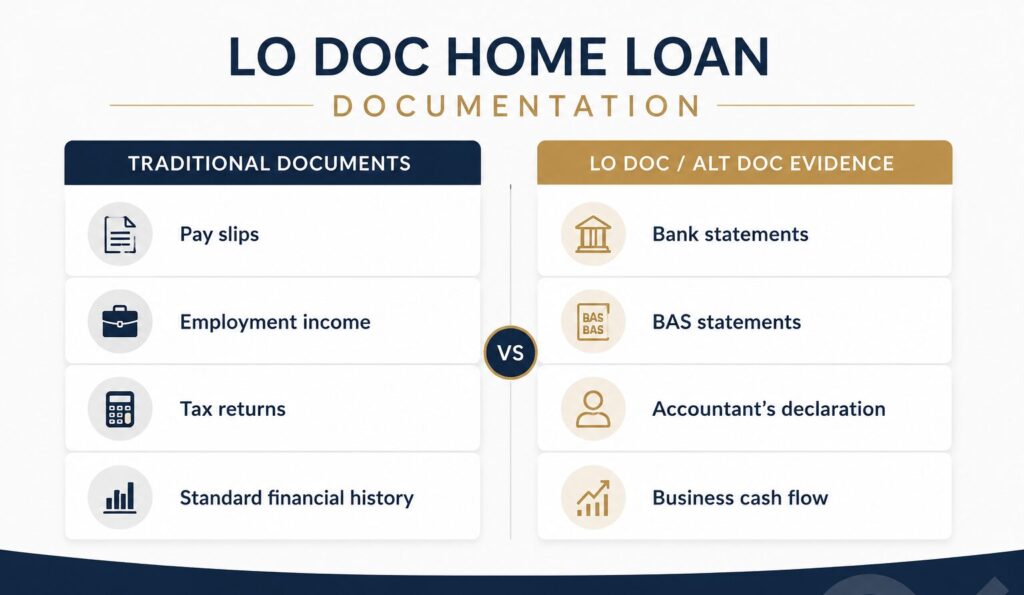
For example, instead of needing to provide a number of pay slips from recent years, a low doc home loan may allow you to provide bank statements to show your last years’ worth of income, as well as an accountant’s declaration outlining your usual annual income.
Low doc home loans fill a critical void in the marketplace for borrowers that have valid income but are unable to provide typical documentation to support that income. These types of borrowers often have complex financial situations and can be approved for a home loan provided they have the right documentation to support their income.
Key points of low doc home loans include:
- Reduced documentation requirements
- Flexibility in income verification
- Tailored for self-employed or irregular income earners
In summary, low doc home loans are a convenient option when borrowing for a home purchase. They can be used by individuals who have a valid income source, but who are unable to provide sufficient documentation to obtain a standard home loan.
Who Are Low Doc Home Loans For?
Low doc home loans are well suited to self-employed individuals who have varied and unusual income and therefore have not got sufficient financial documents to support an application for a standard home loan.
This loan is also suitable for freelancers and contractors, whose income can be sporadic or irregular from one year to the next, and who therefore find it difficult to provide standard loan documentation regarding their income.
It will also benefit the many entrepreneurs and individuals who are involved in small businesses. As these individuals are often exposed to fluctuations in income as a result of business cycles, they can find it difficult to gain approval for traditional home loans.
Key beneficiaries include:
- Self-employed individuals
- Freelancers and gig workers
- Small business owners
In summary the low doc home loans are for those with unique financial situations, allowing individuals with complex income structures to secure a home loan.
Key Features of Low Doc Home Loans
Low doc home loans are different to regular loans in terms of income verification. For a low doc home loan the amount of documentation required to verify income is minimal. This makes the process of trying to obtain a home loan application a lot simpler for the borrower.
Low Doc home loans are generally processed and approved in a much quicker time frame than their traditional finance counterparts. Quick approval home loans have become very popular with many lenders offering this type of finance due to the simplified processing of Low Doc loans.
Some of the low doc home loans on the market might charge higher interest rates but this is to offset the risk that the lender is taking on board. In the end, as with any financial product, it is all about getting the best interest rate available and that is achieved by looking around at all of the different home loans on the market and comparing them to each other.
As with other types of home loans, borrowers of low doc home loans will typically need to make a larger deposit to secure the loan. This can be beneficial to borrowers in securing the loan as well as mitigating risk for the lender.
Key features include:
- Flexible documentation requirements
- Faster approval process
- Potentially higher interest rates
- Larger deposit requirements
Knowing the features of a Low Doc Home Loans can help you to identify the advantages and disadvantages of these home loans and help you with your financial planning by deciding whether a Low Doc Home Loan is suitable for you or not.
Benefits of Low Doc Home Loans
Low doc home loans are suitable for self-employed individuals. Many loans for homes require proof of income on a regular basis, but for self-employed individuals this can be problematic. Low doc home loans are a suitable alternative and enable the self-employed individual to obtain a home loan.
The second benefit of low doc home loans is that they have less documentation than regular home loans. As a result, the application for a low doc home loan is much easier than for a regular home loan. This makes for a great experience for the applicant.
Many of the Low Doc Home Loans also offer fast access to funds to purchase homes with lower documentation required than standard home loans. This enables people to enter the property market quickly and before another buys the home they want.
A Low Doc Home Loan is flexible; The key advantage of Low Doc Home Loans is their flexibility. The type of loan a borrower needs will be specifically designed to enable the borrower to meet their financial objectives.
Benefits include:
- Accessibility for self-employed individuals
- Streamlined documentation requirements
- Faster access to funds
- Flexible, tailored financial solutions
For people seeking financial solutions to purchase homes, low doc home loans are one of the best options available on the market. They are a practical solution for various circumstances of home loan applicants.
Risks and Considerations
The higher interest rates on low doc home loans are one of the biggest risks to borrowers. Because these loans are riskier for lenders, they charge higher interest rates to compensate for the risk. This can make the loan more expensive than a traditionally secured home loan.
Some low doc home loans demand a larger deposit to start repaying the loan as soon as possible. These larger upfront payments can act as a deterrent to many borrowers who are weighing up the pros and cons of a home loan. It is therefore very important to consider the costs and charges of the loan and compare them to other low doc home loans on the market.
In addition to the interest rate, low doc home loans have the potential to incur extra fees. These may be charged by the lender due to the loan being ‘low doc’. They also need to be taken into consideration when working out the true affordability of the loan.
Borrowers should consider:
- Higher interest rates
- Larger deposit requirements
- Potential additional fees
The key to managing the risks associated with a low doc home loan is to have a solid understanding of the loan and the associated costs. As a potential homeowner, you must have a good understanding of your own finances and be able to assess whether or not you will be able to meet the terms of your loan. Choosing the right lender with the right terms and conditions of the loan is also vital in order to minimise risk.
Eligibility Criteria and Required Documentation
Low doc home loans generally have less stringent requirements in relation to documentation than a typical home loan, however there are still certain requirements that must be met. Lenders will assess the applications based on certain criteria to ensure that the borrower is able to repay the loan.
A stable income history can be verified without the usual documentation. For a low doc home loan, lenders want to make sure that you have the ability to repay the loan, and this can be proven by your current earnings. A good credit score is also an important aspect, as it shows the lender that you are able to manage your finances effectively.
Documentation for low doc home loans is alternative in nature and often similar to what is required for an alt doc home loan. This can include income declarations from an applicant’s accountant, their personal tax returns, or their business activity statements. In some cases, lenders will also request to view bank statements in order to assess cash flow.
- Income declarations from an accountant
- Tax returns or business activity statements
- Bank statements as proof of cash flow
Self-verification of the borrower’s income is common in low doc home loans. This means that the borrower will be required to declare their income themselves. While this is generally an easier way for borrowers to obtain a home loan it is important that the information provided is accurate as this information will be used to determine whether the borrower can afford to repay the loan.
Having an understanding of the eligibility criteria and documentation that the lender requires will make the application process a lot easier and help the borrower to have realistic expectations of the home loan that the lender can offer.
Application Process: Step-by-Step Guide
Below are the steps for an application for a low doc home loan.
All that is required is a simple collection of documents such as income statements, bank statements and Business Activity Statements for example.
When applying for a low doc home loan it is best to do some research to compare the different lenders that offer these types of loans. Each lender has different terms and interest rates, so it is best to do some research to find the best loan to suit your individual circumstances.
The application process typically includes:
- Completing a loan application form
- Providing alternate income verification
- Submitting identification and credit history
- Arranging a property valuation
Once you have submitted your application, it is only natural that you will be required to answer additional questions posed by your lender. This will speed up your loan approval processing if you are communicative and able to provide prompt answers to any questions you are asked.
Finally, there is the time will come when you get approved for a home loan. It is very important that you read the terms and conditions of any home loan contract carefully before signing. Make sure you know exactly what your repayments will be and what any fees are for.
Comparing Low Doc, Alt Doc, and Traditional Home Loans
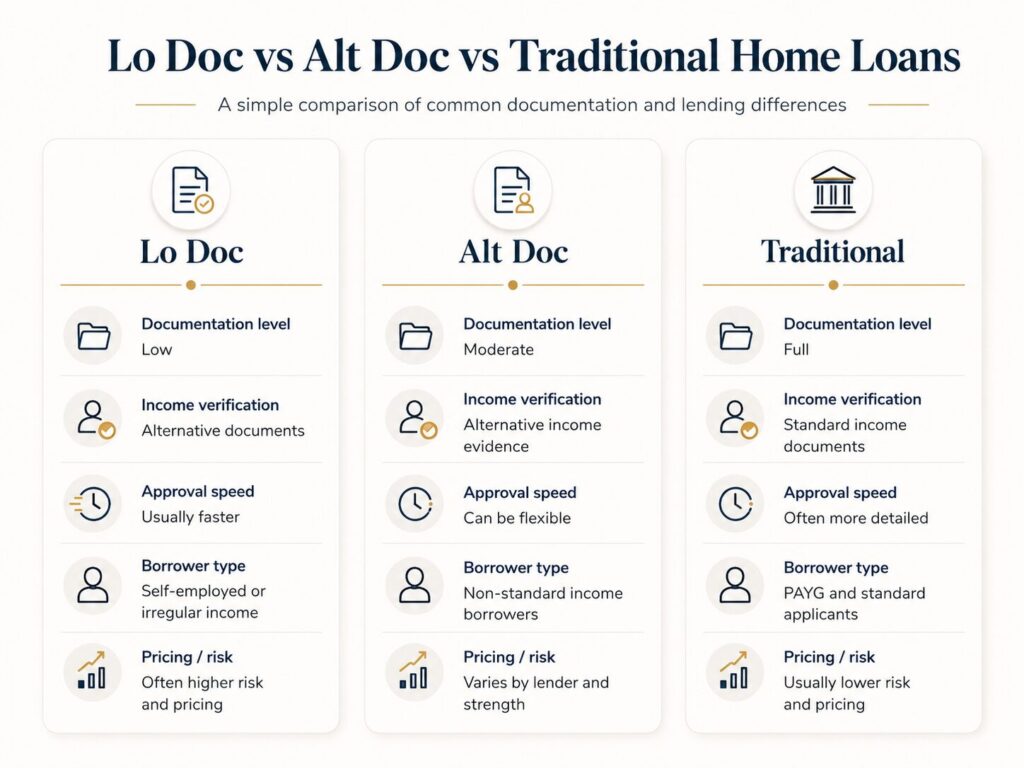
When comparing home loans such as Low Doc Home Loans, Alt Doc Home Loans and Traditional Home Loans it is very important to remember that each loan option has been designed to cater for different borrowers and their individual situations.
Low Doc home loans have minimal paper work required for approval, making these types of home loans suitable for self-employed individuals very attractive as approval can occur quickly.
An alt doc home loan is also another type of loan that requires minimal documentation however they do allow more flexibility with income proof. They are ideal for people who have irregular income and do not have enough proof of income to obtain a traditional home loan.
In traditional home loans more documentation is required to assess the lender in order to assess the borrower’s ability to repay the loan. Such documentation could include pay stubs and tax returns for the last 2-3 years as well as other information that details the borrower’s financial history. Approval for traditional home loans are typically faster than low doc home loans and often come with lower interest rates however the process is longer and can be more rigorous than other types of home loans.
When choosing a loan, consider the following:
- Documentation requirements
- Flexibility in income proof
- Approval speed and interest rates
Whether the advantages of each loan type will apply to you will depend upon your individual circumstances as well as your particular circumstances in terms of your financial affairs and your documentation.
Tips for Getting Approved for a Low Doc Home Loan.
Securing approval for a low doc home loan can be easier with some preparation and by knowing what the lenders are looking for when it comes to low doc home loans.
A good credit score will help increase your chances of being approved for a low doc home loan. A good credit history also shows that you have managed to pay your bills on time which is a very important indicator for any lender.
You must also have alternative documentation prepared to substantiate your income and credit worthiness. Examples of alternative documentation that can be used include your last 6 months bank statements, a letter from your accountant declaring your income, etc.
When applying, consider these tips:
- Check your credit report for accuracy
- Gather relevant financial documents
- Save for a sizable deposit
- Demonstrate consistent income streams
With some planning and understanding of a lender’s requirements you can increase your chances of approval for a Low Doc Home Loan.
Frequently Asked Questions About Low Doc Home Loans
Many people are unsure as to what low doc home loans are and whether they would be suitable for their financial circumstances. Below we outline some of the more frequently asked questions about low doc home loans and how they work.
Another major question that people have in relation to low doc home loans is that of the deposit required. Often people assume that low doc home loans require very low deposit payments. While it is true that there are low doc home loans that allow for low deposit payments (for example 5% deposit home loans or even 100% home loans), typically low doc home loans require higher deposit payments than traditional home loans (for example 20% deposit home loans).
Another factor that is of concern to borrowers is that the interest rates of low doc home loans are generally higher than that of regular home loans because the lender is taking on more risk.
Here’s a quick list of common questions:
- What is the typical loan term for low doc home loans?
- Are self-employed individuals eligible?
- How do I prove my income?
- Can I switch to a traditional loan later?
Understanding the FAQs for low doc home loans will help you to work out whether a low doc home loan will suit you.
Conclusion: Is a Low Doc Home Loan Right for You?
Considering whether a low doc home loan is right for you will depend greatly on your personal financial circumstances. If you are struggling to provide sufficient traditional income proof then a low doc home loan will be one of your best options to consider.
By carefully weighing up the benefits and the risks of the low doc home loans you have considered, in light of your longer term financial objectives, you can then make an informed decision about whether to proceed with a home loan application via a low doc home loan product. It is wise to seek advice from financial experts that can aid in your decision and assist you with your application for a home loan via a low doc home loan that can help you achieve your goal of homeownership.
Seek advice from a financial expert to help work through your options and make informed decisions about your financial future.
