


Can my SMSF buy property?
Yes, if the investment genuinely serves your retirement savings. Every SMSF investment must pass the sole purpose test, which asks one question: is this asset held to provide retirement benefits for members, or for some other reason?
That test rules out the ideas people most often arrive with. You and your relatives cannot live in a residential property the fund owns, cannot rent it, and cannot use the holiday house for a week in January. The property is the fund’s, not yours, until retirement.
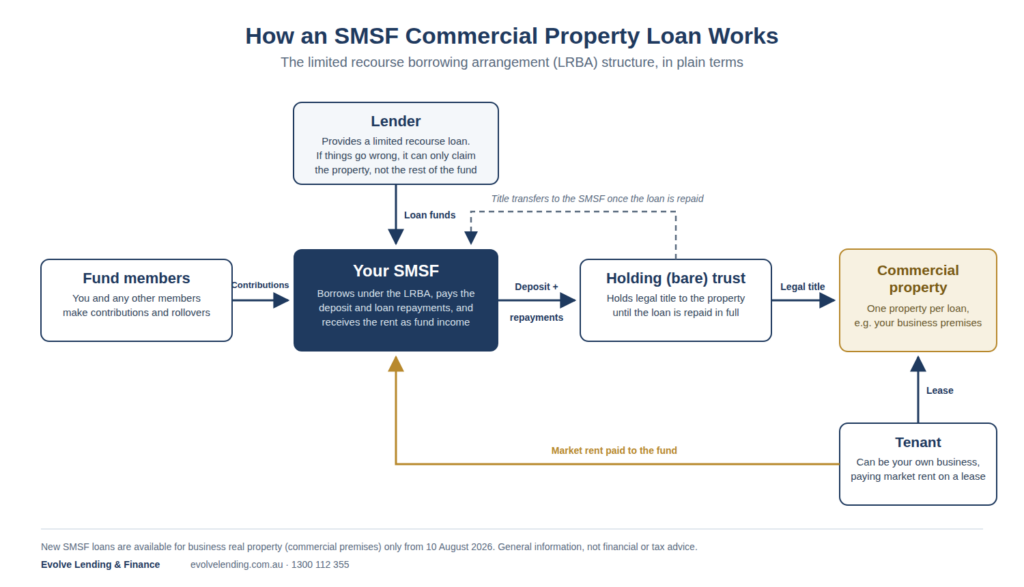
The big exception is business real property. Your fund can buy commercial premises, lease them to your own business at a market rent, and the rent your business pays becomes income of your super fund instead of a landlord’s. For business owners tired of rent reviews, that is usually the conversation worth having.
How does an SMSF loan actually work?
The fund borrows under a limited recourse borrowing arrangement, or LRBA. The property is held in a separate holding trust, often called a bare trust, until the loan is repaid, and if things go wrong the lender can only claim that property, not the rest of the fund.
The structure is strict. One loan buys one asset. Borrowed money can fund repairs and maintenance, but not improvements, and the asset cannot be fundamentally changed while the loan is in place. Getting the trust deed, contract names and loan documents in the right order matters, because errors here are expensive to unwind. We work alongside your accountant on this from the first conversation.
What changed in 2026?
From 10 August 2026, real property that is not business real property can no longer be acquired under a new LRBA. In plain terms, new residential SMSF loans have ended.
Existing arrangements are grandfathered. A residential LRBA already in place keeps running, contracts exchanged before the start date can still settle, and existing loans can still be refinanced, which matters because plenty of older SMSF loans are sitting on rates worth reviewing. Commercial and business real property borrowing continues unchanged. Separately, an additional tax on earnings attributable to balances above $3 million commenced on 1 July 2026, which is a conversation for your accountant or adviser when weighing how much property belongs in the fund.
What do lenders require for an SMSF loan?
The major banks left this market years ago, so SMSF lending now sits with a smaller panel of non-bank and specialist lenders, and their requirements are firmer than standard lending. As a working guide, expect maximum loan to valuation ratios around 70 to 75 per cent for commercial property, a liquidity buffer of roughly 10 to 15 per cent of the fund kept in cash or liquid assets after settlement, and most lenders wanting a fund balance comfortably into six figures before the numbers work.
Every lender assesses SMSF loans differently, and the figures here are a guide only. What your fund can actually do depends on a full assessment, which we complete before recommending anything.
Is SMSF property investment right for you?
Sometimes the honest answer is no, and we will say so. A fund that would hold one illiquid asset and little else, or that relies on contributions that may not continue, is usually better served waiting. SMSF lending is complex work, so we charge a fee for service, explained fully before we start, with half payable when we lodge and the balance only if the loan is approved.
This is general information, not financial or tax advice. Whether an SMSF should buy property at all is a decision for you with your accountant or licensed adviser. What we bring is the lending: which lenders will fund it, on what structure, and whether it is possible now, possible with changes, or not yet.
Talk it through
If you are weighing up a property purchase inside super, particularly your own business premises, talk to SMSF lending specialists before you spend a dollar, and bring your accountant if you like. Call 1300 112 355. A real person answers, 24 hours a day.