


What is negative gearing and how does it work?
A property is negatively geared when its deductible costs are higher than its rental income. The shortfall is a loss, and under current law that loss offsets your other income, such as salary, reducing the tax you pay.
A simple example. A property rents for $30,000 a year, and interest, rates, insurance, management and maintenance total $40,000. The $10,000 loss reduces the owner’s taxable income, so someone on a 37 per cent marginal rate gets about $3,700 back at tax time. The other $6,300 is real money gone, covered from their own pocket. That is the point people miss: negative gearing softens a loss, it does not create a profit. The strategy only works if the property grows in value by more than the accumulated losses cost you.
How is negative gearing changing?
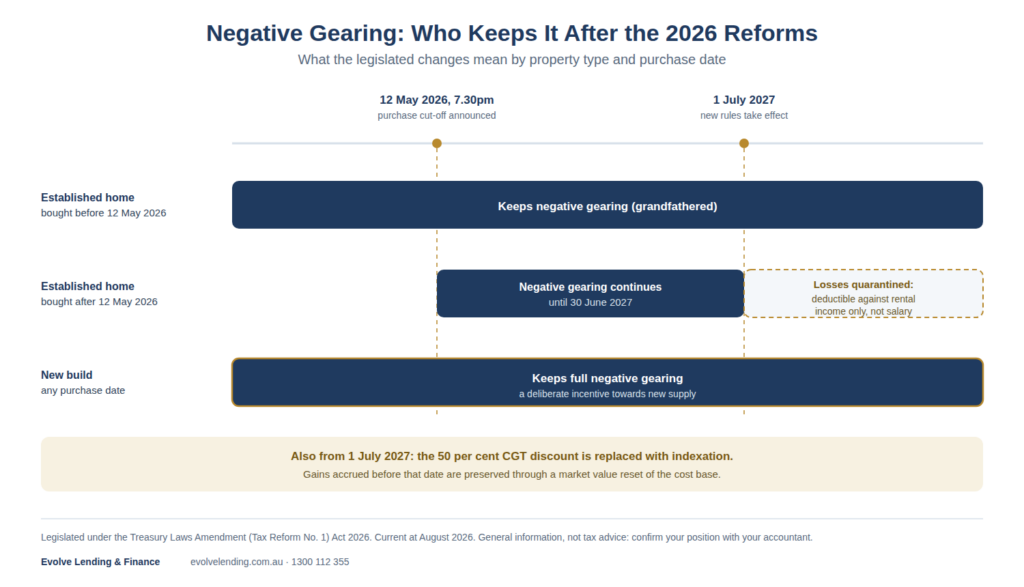
From 1 July 2027, losses on established residential properties purchased after 7.30pm on 12 May 2026 can no longer be offset against salary and other income. Those losses are instead quarantined, meaning they can only be used against residential rental income, now or in future years.
Three groups keep negative gearing as it stands. Properties held before 12 May 2026 are grandfathered. New builds remain fully negatively gearable, which is a deliberate push towards new supply. And everyone keeps the current rules until 30 June 2027, so an established property bought today can still be negatively geared for the 2026-27 year before the quarantine begins.
The 50 per cent capital gains tax discount is also being replaced from 1 July 2027 with a new indexation approach, with accrued gains on existing holdings preserved through a market value reset. The detail there is one for your accountant, but the direction is clear: the tax tailwind behind established-property investing is easing, and new builds are being favoured.
Is negative gearing still worth it?
It was never worth pursuing for its own sake, and that is truer now. A deliberate loss only makes sense while the growth story holds and while your cash flow comfortably carries the shortfall, including at higher interest rates than today’s.
What changes from here is the comparison between property types. For a purchase after 12 May 2026, a new build keeps the full deduction against your salary while an established home will not from July 2027, and that difference belongs in the numbers before you buy, alongside the things that always mattered more: the property itself, the yield, and your buffer.
What can you still claim on an investment property?
Loan interest, property management fees, rates, insurance, repairs and maintenance remain deductible against rental income. Capital works, the building itself, generally depreciate at 2.5 per cent a year.
Two long-standing limits still catch people. Travel to inspect a residential rental property has not been deductible since 2017, and depreciation on second-hand plant and equipment, such as the ovens and carpets that came with an established property, is generally not claimable either, another quiet advantage for new builds. This is general information, not tax advice; your accountant should confirm what applies to you.
What does all this mean for your loan?
Structure matters more than ever. How the loan is set up, whether repayments are interest-only or principal and interest, how offsets are used and whether the property stands alone or is crossed with your home all shape both the tax outcome and your risk. Lenders also assess investment lending differently from owner-occupied, with different pricing and stress-tested repayments, so what you can borrow is a question with a specific answer, not a calculator estimate.
Talk it through
If you are weighing an investment purchase, or you hold an established property and want to know what the 2027 changes mean for your position, the lending side is our job. We will assess your scenario properly, tell you where current investment loan rates and structures sit for someone in your position, and give you a straight answer on what is possible. Call 1300 112 355. A real person answers, 24 hours a day.