

Understanding Corporate Debt Restructuring Strategies
Every business experiences financial ebbs and flows, but what happens when the tide goes out and does not come back in? When a company finds itself under the weight of financial obligations, corporate debt restructuring often emerges as one of the most viable lifelines. Rather than signalling the end of a business, restructuring is a proactive, strategic process designed to align a company’s capital structure with its current operational realities.
Whether you are a business owner, a financial executive, or simply an interested observer, understanding the mechanics of reshaping corporate liabilities is essential. Let’s examine the strategies, legal frameworks, and negotiation tactics that can help bring a struggling enterprise back from the brink.
Recognising the Early Warning Signs
The first step in any successful restructuring is acknowledging that a problem exists. Leaders often wait until cash reserves are entirely depleted before acting, which severely limits their options. Identifying the signs of business financial distress early can mean the difference between a minor operational pivot and a complete corporate collapse.
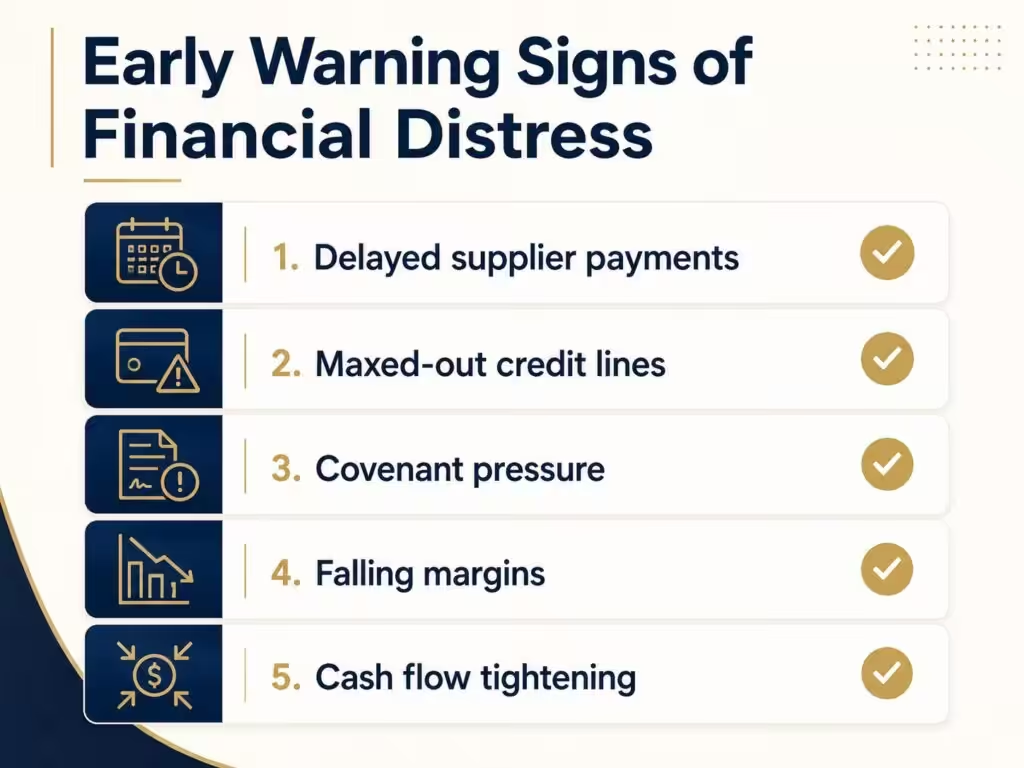
Common red flags include:
- Consistent delays in paying trade creditors or suppliers.
- Maxed-out overdrafts or lines of credit with no clear path to reducing the principal.
- High employee turnover, particularly within the finance department.
- Declining profit margins despite steady or increasing sales.
Another critical early warning sign is the impact of covenant breaches on liquidity. Commercial loans often come with strict financial covenants, such as maintaining a specific debt-to-EBITDA ratio. If a company’s earnings dip, it may breach these covenants. When this happens, lenders can freeze credit lines, restrict further drawdowns, or demand immediate repayment, which can quickly damage the company’s cash flow.
This often leads to the need for addressing technical default on loans. A technical default means you have not necessarily missed a payment yet, but you have breached a structural condition of the loan agreement. Engaging lenders proactively at this stage is much easier than trying to negotiate after a missed payment.
Formulating a Resilient Corporate Debt Strategy
Once distress is identified, you cannot simply ask creditors for forgiveness without a plan. You must develop a comprehensive corporate debt strategy. This master plan outlines how the business will stabilise its finances, communicate with stakeholders, and ultimately return to profitability.
A major pillar of this strategy involves improving company cash flow during crisis. Before you can restructure long-term debt, you need short-term survival cash. Actionable tips for immediate cash flow improvement include:
- Aggressive accounts receivable: Offer discounts for early payments from your clients to pull forward cash.
- Asset realisation: Sell off non-core assets, idle machinery, or excess inventory.
- Cost freezes: Halt all non-essential hiring, travel, and capital expenditure.
With immediate liquidity stabilised, leadership can begin looking at the structural restructuring of the debt itself.
Core Tactics for Restructuring Corporate Liabilities
There is no one-size-fits-all approach to corporate debt restructuring. Depending on the severity of the financial distress and the willingness of creditors to cooperate, companies can use several different financial strategies.
Loan Forbearance Agreements
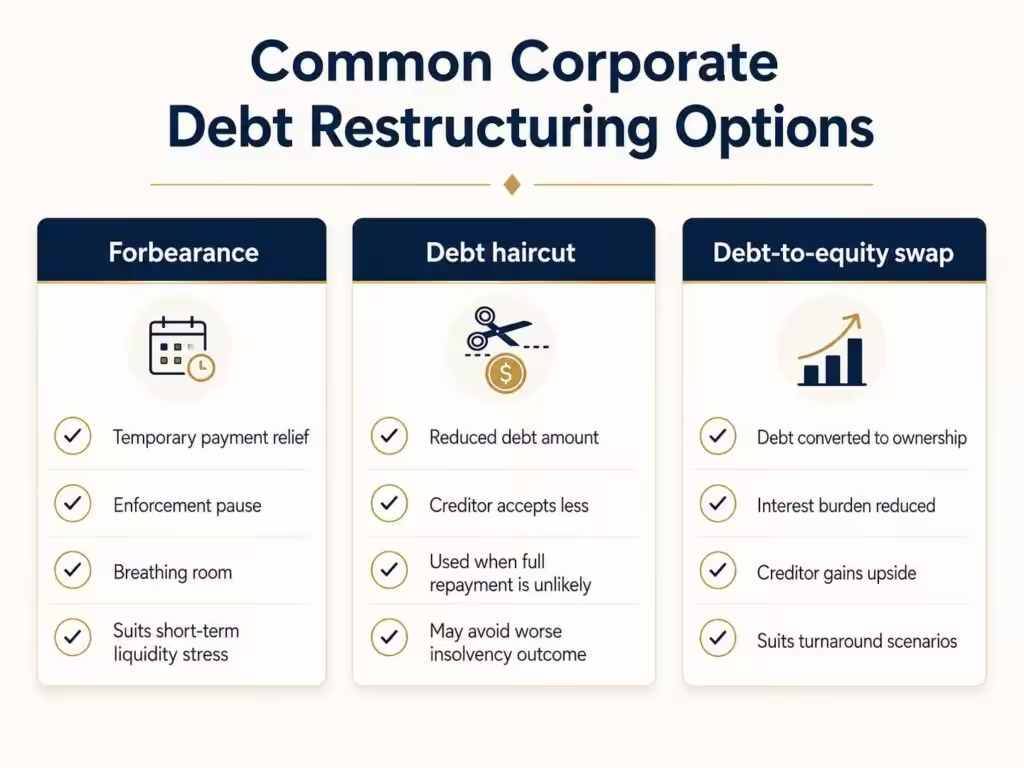
One of the most immediate tools available is a forbearance agreement. The benefits of loan forbearance agreements cannot be overstated for a company in a liquidity crunch. In this arrangement, the lender agrees to temporarily pause or reduce debt payments and refrain from taking enforcement action against secured assets. This crucial breathing room allows the company time to stabilise operations, sell assets, or secure alternative finance without the immediate threat of default enforcement.
The Debt Haircut
If the company is structurally unable to repay the full principal of its loans, it may negotiate a “haircut”. But what happens during a debt haircut? Essentially, the creditor agrees to accept less than the total amount owed as full payment. For example, a lender might forgive 20% of a $5,000,000 loan, accepting $4,000,000 to clear the debt. Lenders agree to this when they believe that forcing an insolvency process may result in them recovering even less, or possibly nothing at all.
Equitising the Debt
Another common tactic is converting what the company owes into company ownership. The debt-to-equity swap process involves a creditor cancelling a portion of the company’s debt in exchange for shares in the company.
- For the company: It instantly reduces the debt burden and eliminates the associated interest payments, freeing up cash flow.
- For the creditor: While they take on more risk as an equity holder, they gain a chance to recover their investment, and potentially profit, if the business turns around.
The Negotiation Battlefield: Working with Creditors
Restructuring is essentially an ongoing, high-stakes negotiation. How you approach these discussions depends heavily on the type of creditor you are dealing with.
When negotiating with secured creditors, you must tread carefully. These lenders hold security over specific company assets, such as real estate, equipment, inventory, or other business assets. Because their loans are backed by collateral, they have significant leverage. Whether you are dealing with major banks, private credit providers, non-bank lenders, or navigating the specific requirements of secured business loans in Australia, the core principle remains the same: you must prove to the secured lender that keeping the business alive as a going concern will yield a higher return than enforcing against the assets today.
Conversely, dealing with unsecured corporate debt requires a different approach. Companies with bondholders, noteholders, unsecured lenders, trade creditors, or other unsecured finance arrangements may need to negotiate with multiple parties at once. Effective creditor negotiation tactics involve strong transparency. Because unsecured creditors often have varying interests, finding consensus can be difficult. Successful negotiators use a combination of incentives and consequences, offering revised terms or improved recovery prospects while making clear what the likely outcome may be if the business enters a formal insolvency process.
Formal vs Informal Restructuring Pathways
Understanding how to manage corporate insolvency requires knowing your legal avenues. Broadly speaking, restructuring happens in two arenas: informally through negotiation, or formally through an Australian insolvency or restructuring process.
Informal Settlements
Whenever possible, distressed businesses often aim for an informal restructuring. When analysing voluntary administration versus an informal settlement, the latter is usually faster, cheaper, and more private. It involves mutual agreements negotiated directly with lenders and creditors without the same level of formal external control.
The downside is that it may require unanimous or near-unanimous creditor support. If one major holdout creditor refuses to agree, an informal deal can collapse.
Formal Insolvency and Restructuring Proceedings
When informal negotiations fail, companies may need to turn to the formal legal framework for business debt relief. In Australia, this may involve voluntary administration, a deed of company arrangement, receivership, liquidation, or, for eligible smaller companies, the small business restructuring process.
Small Business Restructuring, often referred to as SBR, is a streamlined Australian restructuring process for eligible incorporated small businesses. It is designed to help viable companies restructure debts while the directors remain in control of day-to-day operations, under the supervision of a registered restructuring practitioner. SBR may be relevant where a company is insolvent or likely to become insolvent, has liabilities below the eligibility threshold, and can put forward a realistic proposal to creditors. It can be less disruptive than voluntary administration, but it is not suitable for every business and should only be considered with specialist insolvency, legal and accounting advice.
A formal legal process can help bind creditors to an agreed restructuring outcome, subject to the relevant process, creditor voting and legal requirements. It may also provide breathing space from certain enforcement actions while the company’s position is assessed.
During this phase, stakeholders must deeply evaluate liquidation versus restructuring for businesses.
- Restructuring or voluntary administration: The business may continue operating while debts are renegotiated, assets are sold, contracts are reviewed, and a formal proposal is put to creditors.
- Liquidation: The business is deemed unviable. Operations cease, assets are sold by a liquidator, and the proceeds are distributed to creditors according to legal priority.
Directors also need to be aware of their duties during financial distress, including insolvent trading risks and the potential relevance of safe harbour provisions. Specialist legal, accounting and insolvency advice should be sought early.
Leading the Turnaround Process
Financial restructuring alone cannot save a fundamentally flawed business model. To achieve lasting success, the financial overhaul must be paired with operational distressed company turnaround strategies. This involves critically assessing product lines, market fit, management capability, overhead costs, pricing, staffing, supplier arrangements and the company’s broader operating model.
You might restructure the debt perfectly, but if the core business is still burning cash, you will end up right back where you started.
Because existing management is often emotionally tied to the current business structure, and may have lost the trust of creditors, bringing in outside expertise is often recommended.
This is where the role of a chief restructuring officer, or CRO, can become vital. A CRO is a specialised executive brought in to steer the company through the crisis. The CRO is responsible for:
- Providing objective, unemotional analysis of the company’s viability.
- Taking over communications with lenders and rebuilding trust through transparency.
- Identifying operational inefficiencies and executing swift cost-cutting measures.
- Overseeing asset sales and debt negotiation processes.
By placing a CRO at the helm, the CEO and management team can focus on running the day-to-day operations of the business, ensuring that revenue does not deteriorate further while the complex restructuring plays out in the background.
The Takeaway: A Catalyst for Corporate Renewal
Corporate debt restructuring is a daunting, complex, and highly stressful process. However, it is important to view it not simply as a defeat, but as a strategic tool for corporate renewal. By acting quickly at the first signs of financial distress, aggressively managing cash flow, and engaging openly with creditors, companies can navigate difficult periods more effectively.
Whether using informal forbearance agreements or formal Australian restructuring and insolvency processes, the ultimate goal remains the same: preserving the core value of the business, protecting jobs where possible, and emerging on the other side as a stronger, leaner, and more competitive entity.
With the right corporate debt strategy, expert guidance, and a willingness to make tough operational choices, a distressed balance sheet does not have to dictate a company’s final chapter.
