
Single Security Bridging Finance Before a Private Loan Deadline

When people think about bridging finance and bridging loans, they usually think about a client buying a new property before selling their current one. In that situation, there are normally two properties involved: the existing property being sold and the next property being purchased.
This scenario was different. It is also a useful way to see bridging finance explained in practice when a single property needs time and flexibility.
The client did not yet have a new property under contract. She was not trying to settle on a purchase while waiting for her existing home to sell. Instead, she needed time, control and breathing room around one high-value property.
Her existing private loan was due to expire, and the practical deadline was even tighter than it first appeared. The private lender required the loan to be rolled over within approximately three weeks, otherwise the client risked further pressure around the loan, including the possibility of the property needing to be sold to recover the lender’s debt, accrued interest and fees.
The private loan balance was approximately $6.6 million and was secured against her home in Vaucluse. The property had strong underlying value, with the client’s own estimate above $15 million and local agent appraisals suggesting the home could achieve up to $20 million for the right buyer, largely due to its location and water views.
The challenge was not whether the property had value.
The challenge was timing, income, valuation risk and lender pressure.
The Client’s Position
To protect the client’s privacy, we’ll call her Claire.
Claire had originally taken out the private loan to buy out her former partner’s interest in the property following their separation. This allowed her to retain ownership of the home at a difficult and important point in her life.
However, by the time she came to us, the private loan was approaching expiry and she was not in a position to refinance through a standard bank.
She was not working, had no regular income and was living from her savings. From a traditional lender’s perspective, this created a major servicing issue, even though the property itself had significant equity.
The private lender had offered to extend the loan, but the extension came with a further establishment fee of 1.2%, additional valuation and legal costs, and another 12-month period of capitalised interest.
The rate itself, at around 9.5%, was not unusual for that type of private lending. The bigger issue was the total cost, the short extension period and the pressure it placed on Claire to make major decisions quickly.
If she did not roll the loan over, the lender’s position was that the property may need to be sold to recover the debt, accrued interest and fees.
That left Claire facing a difficult choice: pay a significant amount to extend the private loan for only 12 months, or be pushed into selling a unique property before she was fully ready.
The Added Complexity
There was another issue affecting the sale process.
A challenging neighbour had created problems along the property boundary, including storing rubbish and putting up signs that suggested legal disputes. This had the potential to affect how valuers, buyers and agents viewed the property.
For a high-value home, especially one where the right buyer may pay a premium for position, presentation and outlook, these details matter.
Claire did not want to be forced into a rushed campaign while still dealing with final improvements, presentation issues and buyer perception concerns. She needed enough time to prepare the property properly, manage the situation and then sell from a stronger position.
Why Standard Bridging Finance Was Not the Right Fit
A normal bridging loan is usually structured around a clear transaction: the borrower owns one property, buys another, and then sells the existing property within a set timeframe.
That was not Claire’s situation.
She had one property. No new purchase had been found. Her goal was to refinance the existing private loan, complete improvements and then sell the home without being forced into a short deadline.
This is where single security bridging finance became relevant.
Single security bridging finance can sometimes be used where the loan is secured only against the current property, rather than being tied to both an existing property and a new purchase. It is not a standard home loan solution, and it is not suitable for every borrower. But in the right circumstances, it can provide time and flexibility where the exit strategy is clear.
In Claire’s case, the exit strategy was the eventual sale of the Vaucluse property, with no ongoing end debt required.
Managing Valuation Risk
One of the key parts of the transaction was managing the valuation risk before it became a problem.
Although the client’s estimate and agent appraisals suggested a much higher property value, we knew the lender’s valuation could come in lower. Rather than building the application around the most optimistic figure, we structured the proposal with enough room to absorb a valuation as low as $10 million.
That proved important.
The bridging lender’s valuation came in at $11.5 million. This was still a strong valuation, but it was lower than the client’s expected value and meant the loan-to-value ratio was higher than first anticipated.
Because we had already allowed for a lower valuation in the application structure, the approval did not need to be varied. There was no need to go back and redesign the loan, reduce the requested amount or renegotiate the transaction at the worst possible time.
That preparation helped protect the deal under deadline pressure.
The Solution
We worked through the scenario with lenders that could consider the strength of the security, the client’s position and the intended sale pathway.
The structure we secured was a 24-month single security bridge loan facility, secured against the current home only.
The new loan allowed Claire to refinance the $6.6 million private debt, capitalise interest, and release an additional $200,000 in cash out. That cash out was important because it gave her funds to complete final renovations and improvements before bringing the home to market.
Instead of being forced into a rushed sale, Claire now had time to improve the property, prepare the campaign properly and wait for the right buyer.
The facility was also structured with no end debt. The plan was simple: complete the improvements, sell the property, repay the bridging facility from the sale proceeds, and then use the remaining funds to purchase the next home once her actual budget was known.
Working Under a Tight Deadline
The timing was critical. In a market where fast bridging loans are often requested, speed still had to be balanced with due diligence.
Although the original loan expiry was close, the immediate rollover deadline with the private lender created a much tighter three-week window. That meant the bridging loan application process, valuation, approval, loan documents, settlement process and payout of the private lender all had to move quickly.
We worked closely with the lender and all parties involved to keep momentum in the transaction and push the file through to settlement in time.
The private loan was paid out before the rollover deadline, avoiding the need for Claire to accept the private lender’s costly extension terms.
The Cost Difference
The new structure produced a material financial benefit.
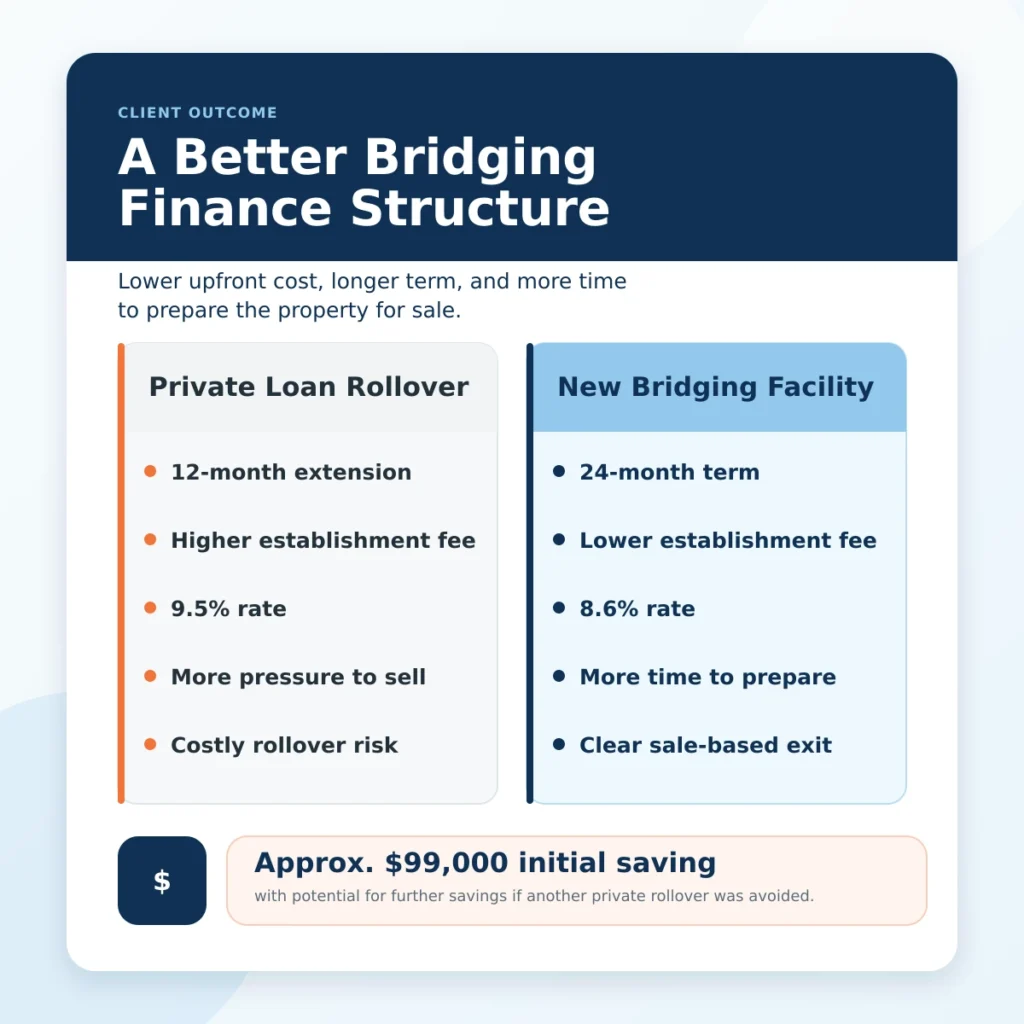
The establishment fee on the new bridging facility was around half of the private lender’s proposed extension fee. More importantly, the new facility provided a 24-month term, while the private lender’s extension would only have covered 12 months.
On a like-for-like basis, the establishment cost over a 24-month period was effectively around a quarter of what Claire may have paid by extending the private loan twice.
The interest rate was also lower, at approximately 8.6% compared with the private lender’s rate of around 9.5%.
Overall, the initial saving to the client was approximately $99,000, with the potential for a further $99,000 saving in 12 months’ time if she would otherwise have needed another private lender extension.
For a client already under pressure, that was not just a better loan structure. It was a meaningful shift in control.
The Outcome
Claire was able to refinance the expiring private loan before the rollover deadline, avoid a costly 12-month extension, access funds to complete final works and create a more realistic timeframe for selling the property.
The new structure gave her up to 24 months, capitalised interest, a lower interest rate and a clearer pathway to exit.
Just as importantly, the transaction held together even when the valuation came in lower than the client’s estimate. Because the application had been structured with room for valuation movement, no changes were required to the approval.
Most importantly, Claire was able to sell the property on her terms, not under lender pressure.
Once the property sells, Claire can then decide on her next home based on the actual net sale proceeds rather than guessing her budget in advance.
Why This Matters
This scenario shows why complex lending is rarely just about finding a rate.
On paper, Claire had a valuable property with substantial equity. But without regular income, with a private loan rollover deadline only weeks away, and with valuation risk attached to a unique high-value property, standard lender options were limited.
The right outcome required understanding the property, the debt position, the exit strategy, the timing pressure, the lender market and the importance of building the application around realistic downside assumptions.
Single security bridging finance is not suitable for every borrower, and lender appetite can vary significantly. But where there is strong security, a credible exit strategy and a clear reason for needing time, it may provide an alternative to costly private debt or a rushed property sale. Often, the best bridging loans are defined less by headline rate and more by a credible exit strategy and structure tailored to the borrower.
For Claire, the right structure gave her time, reduced upfront costs, absorbed valuation risk and helped protect the value of a major asset.
Q&A
Question: What is single security bridging finance, and how is it different from a standard bridging loan?
Short answer: Single security bridging finance is secured only against the borrower’s current property and is used to create time and flexibility when the exit is a later sale, without tying the loan to a new purchase. In contrast, standard bridging typically involves two properties—keeping the current home while buying another—and assumes a sale within a set timeframe. In this case, the client had no new purchase in play, so a single security bridge matched her need for time to prepare and sell one high‑value property on her terms.
Question: Why couldn’t Claire refinance with a standard bank or just extend her private loan?
Short answer: She had no regular income, which created a major servicing issue for traditional lenders despite strong equity. Extending the private loan was costly (1.2% establishment fee, added valuation/legal costs, and another 12 months of capitalised interest at about 9.5%) and would keep her under short-term pressure. The single security bridge avoided those pressures by providing a longer term, lower rate, and funds to prepare the property properly before selling.
Question: How was valuation risk managed, and what happened when the valuation came in lower than expected?
Short answer: The application was structured conservatively to work even if the valuation fell to $10 million. The lender’s valuation came in at $11.5 million—below agent appraisals and the client’s estimate—but because the deal was built around downside assumptions, no changes were needed to the approval, amount, or structure. This preparation kept the transaction on track under a tight deadline.
Question: What did the final solution look like, and how did it change the sale process?
Short answer: The team secured a 24‑month single security bridging facility against the existing Vaucluse home. It refinanced the ~$6.6 million private debt, capitalised interest, and provided ~$200,000 cash out for improvements. There was no end debt: the exit was the property’s sale, with the bridge repaid from proceeds. This gave Claire breathing room to address presentation issues (including neighbour-related concerns), complete works, run a proper campaign, and sell when the right buyer emerged—without being forced into a rushed sale.
Question: What was the cost impact versus extending the private loan?
Short answer: The new facility’s establishment fee was about half the private lender’s proposed extension fee, and it offered 24 months instead of 12. On a like‑for‑like 24‑month basis, the establishment cost was effectively around a quarter of what two private extensions might have cost. The interest rate was also lower (about 8.6% vs 9.5%). Initial savings were approximately $99,000, with the potential for a further $99,000 in 12 months if she would otherwise have needed another private extension—plus the practical benefit of reduced pressure and a clearer, longer runway to sell.


Get Clear Lending Insights
More Real Client Outcomes



Move forward with clearer lending advice
Whether you are buying a home, refinancing, investing in property or funding a business, we help you understand your options, assess lender fit and structure the lending properly before you commit to a path forward.