

A borrowing power calculator (sometimes called a home loan calculator, home loan borrowing calculator or mortgage borrowing calculator) can be a useful starting point when you are thinking about buying property, refinancing, investing, building, or simply trying to understand where you stand financially.
Most borrowers want to answer one simple question:
How much can I borrow?
This is the question behind every how much can I borrow calculator.
But in practice, borrowing capacity is rarely that simple.
A loan borrowing calculator can give you an indicative figure, but your actual borrowing power can depend on many factors, including your income type, expenses, debts, dependants, deposit, credit history, property type, loan purpose and the lender assessing your application.
That is why it is important to use a borrowing power calculator as a guide, not a guarantee.
The best calculators do more than produce a single number. They help you understand what may be affecting your position, what could improve your outcome, and when it may be worth speaking with an experienced mortgage broker before applying. A good borrowing calculator should feel like a planning tool, not just a quick estimate.
What is a borrowing power calculator?
A borrowing power calculator, also called a borrowing capacity calculator or home loan calculator, estimates how much a lender may allow you to borrow based on the details you enter. You might also see it described as a borrow power calculator or a how much can I borrow with deposit calculator when deposit fields are included. Common search terms include “mortgage borrowing calculator”, “home loan calculator”, “home loan borrowing calculator”, “borrowing calculator home loan”, “borrowing calculator mortgage”, “loan borrowing calculator”, and “how much can I borrow with deposit calculator” – all referring to similar tools.
Most calculators ask for information such as:
- your income
- your living expenses
- your existing debts
- your credit card limits
- the number of dependants you have
- your deposit or equity
- the loan term
- an indicative interest rate
- whether the loan is for a home, investment property or refinance
The calculator then estimates how much surplus income may be available to service a new loan.
For example, a borrower with strong income, low expenses, no personal debt and a healthy deposit will usually have a stronger borrowing position than a borrower with the same income but high credit card limits, car loans, personal loans and tighter monthly cash flow.
However, this is only the starting point.
Each lender has its own credit policy and assessment method. That means two borrowers with the same income can receive very different outcomes depending on the lender, the structure of the application and how their income and liabilities are treated.
Why borrowing power calculators can produce different results
If you have used more than one borrowing calculator, you may have noticed that the results are not always the same.
One calculator may suggest you can borrow $750,000. Another may suggest $820,000. A third may give a lower figure again.
This does not necessarily mean one calculator is wrong. It usually means the calculators are using different assumptions. In short, each tool may calculate borrowing power using slightly different rules and buffers.
Some calculators may use different treatment for:
- overtime, bonus or commission income
- self-employed income
- rental income
- HECS or HELP debt
- credit card limits
- personal loans and car loans
- dependants
- investment property expenses
- interest rate buffers
- loan terms
- living expense benchmarks
A bank calculator may also reflect that bank’s general appetite, whereas a mortgage broker may consider a much wider range of lenders.
This is important because borrowing capacity is not only about how much you earn. It is also about how a lender interprets your financial position.
What affects your borrowing power?
Several key areas can influence how much you may be able to borrow.
Income
Your income is one of the most important inputs, but not all income is treated equally.
Base PAYG salary is usually simpler to assess than irregular income. Overtime, bonuses, commission, allowances, contractor income, business income and trust distributions may be treated differently depending on the lender.
For self-employed borrowers, lenders may look at tax returns, financial statements, business structure, add-backs, income consistency and the most recent trading position. Some lenders may average two years of income. Others may rely more heavily on the latest year, depending on the circumstances.
This is one of the reasons a standard home loan calculator or mortgage borrowing calculator may not reflect the full picture for self-employed or business-owner borrowers.
Expenses
Living expenses also play a major role.
A calculator may ask you to enter your monthly living costs. Lenders may then compare those expenses against internal benchmarks or minimum living expense measures. If the entered figure appears too low, the lender may use a higher amount for assessment.
Expenses can include groceries, utilities, transport, insurance, subscriptions, school fees, childcare, health costs and general discretionary spending.
A borrower may feel comfortable with their budget, but a lender still needs to assess whether the loan is affordable under its own responsible lending and credit policy framework.
Existing debts
Debts can reduce borrowing power significantly.
Common examples include:
- credit card limits
- car loans
- personal loans
- buy now pay later commitments
- existing home loans
- investment loans
- tax debt or repayment arrangements
- business-related liabilities
Credit cards are a common issue. Many borrowers focus on the balance owing, but lenders often assess the credit card limit, even if the card is paid off each month. Reducing unused card limits can sometimes improve borrowing capacity.
Car loans and personal loans can also have a meaningful impact because they create fixed monthly commitments that reduce available servicing income.
Deposit, equity and LVR
For purchases, your deposit helps determine the size of the loan required and the loan-to-value ratio, commonly called LVR. This is also why some people search for a how much can I borrow with deposit calculator – because factoring in your deposit can change the outcome.
A lower LVR can improve lender comfort and may reduce the risk of lender’s mortgage insurance, commonly known as LMI. A higher LVR may still be possible, but it can reduce lender options and increase costs.
For refinances, the relevant figure is usually your outstanding loan balance compared with the estimated property value. In that case, it is not helpful to ask for a deposit. The existing loan being refinanced should also be treated carefully because the old repayment is generally replaced by the new loan repayment.
Loan purpose
Borrowing power can also vary depending on the purpose of the loan.
A home loan for an owner-occupied property may be assessed differently from an investment loan, construction loan, SMSF loan, business loan or complex refinance.
Construction lending, SMSF lending, business borrowing and previously declined scenarios are often more policy-sensitive. In these cases, a calculator may still be helpful, but the result should not be relied on without a proper review.
What a borrowing power calculator can tell you
A good borrowing calculator can help you understand:
- your estimated borrowing capacity
- your approximate monthly repayment
- your estimated loan-to-value ratio
- whether there may be a gap between your target loan and estimated borrowing position
- whether certain debts may be reducing your capacity
- whether your scenario may be lender-sensitive
- whether you may be ready to apply or need to prepare first
This makes the calculator valuable even if you are not ready to apply immediately, because it helps you calculate borrowing power in context.
For example, if your borrowing estimate is below your target loan amount, the result may help you identify practical next steps. That could include reducing credit card limits, paying out a car loan, reviewing living expenses, increasing your deposit, waiting for updated income documents or speaking to a broker about lenders that may treat your income differently.
What a borrowing power calculator cannot tell you
A borrowing calculator cannot confirm loan approval.
It also cannot fully assess:
- your credit history
- lender-specific policy exceptions
- full document requirements
- genuine savings requirements
- unusual income structures
- business income add-backs
- property-specific concerns
- valuation issues
- changing lender appetite
- whether a lender will accept your explanation for a particular issue
This is where many borrowers get caught.
They may receive a strong calculator result and assume they are ready to apply, only to discover that one part of their situation does not fit the lender’s policy.
The reverse can also happen. A borrower may receive a low calculator result and assume they cannot borrow, when the real issue may be that the calculator has not properly captured their income, structure or lender options.
Why lender fit matters
One of the most overlooked parts of borrowing power is lender fit.
A bank calculator generally gives you an estimate based on broad assumptions. But in the real world, lenders can vary significantly in how they assess different borrower types.
This matters for:
- self-employed borrowers
- borrowers with recent income changes
- borrowers with overtime or bonus income
- investors
- business owners
- borrowers with company or trust structures
- borrowers with existing debts
- borrowers with multiple properties
- borrowers with credit issues
- borrowers who have already been declined
The right lender can make a meaningful difference.
That does not mean every borrower can simply borrow more by choosing another lender. It means your borrowing position should be assessed against the right credit policy, not just a generic calculator.
How to use a borrowing power calculator properly
The best way to use a borrowing power calculator is to treat it as a planning tool, whether you are using it as a home loan borrowing calculator or for investment purposes.
Start by entering realistic figures. Do not understate expenses or ignore debts. The more accurate your inputs, the more useful the estimate will be.
Then look beyond the headline number.
Ask:
- Is the estimate above or below my target loan?
- What debts are reducing my capacity?
- Would reducing credit limits make a difference?
- Does my income type need specialist review?
- Am I relying on overtime, bonus, commission or business income?
- Is my LVR likely to create lender or LMI issues?
- Am I ready to apply now, or should I prepare first?
A calculator is most valuable when it gives you direction, not just a number.
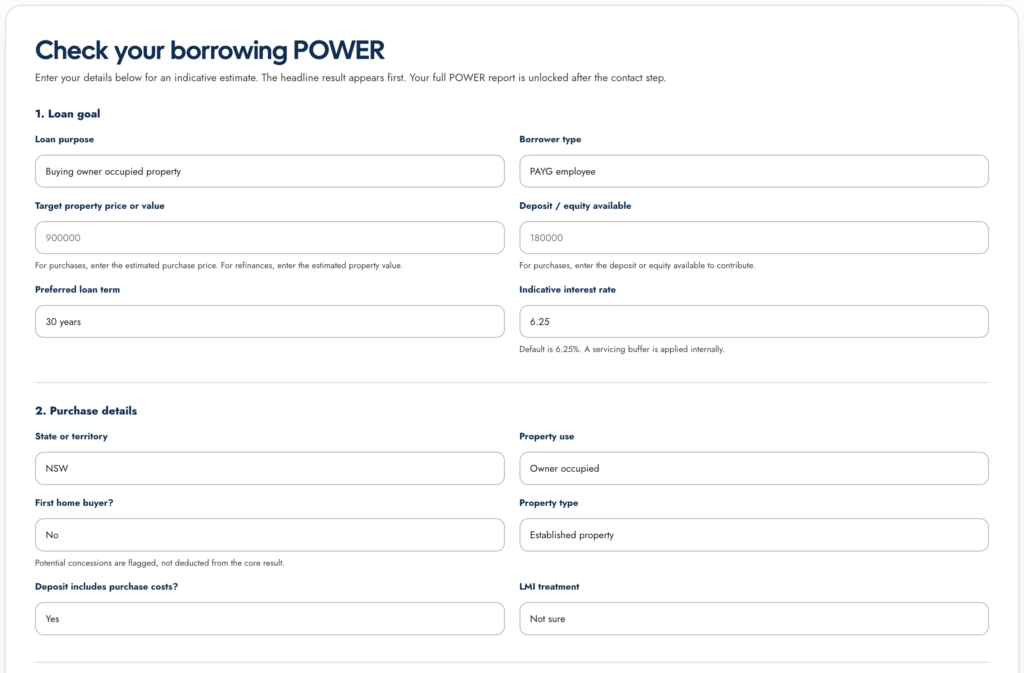
The Evolve Borrowing POWER Calculator
The Evolve Borrowing POWER Calculator has been designed to go further than a standard borrowing calculator. It works as a home loan borrowing power calculator and a practical mortgage borrowing calculator for planning.
Most calculators estimate how much you may be able to borrow. The Evolve Borrowing POWER Calculator is designed to also help you understand what may be influencing that figure.
POWER stands for:
Position – your estimated borrowing position based on the information entered.
Opportunities – possible ways to improve your borrowing power, such as reviewing debts, credit limits, loan term or lender treatment of income.
Weak points – factors that may reduce borrowing capacity or create approval risk.
Eligibility – policy factors that may affect lender fit, especially for self-employed borrowers, investors, business owners, SMSF lending, construction lending or complex scenarios.
Readiness – a confidence timeline to help indicate whether you may be ready now or whether your position may benefit from preparation first.
The calculator can also provide an estimated monthly principal and interest repayment, an estimated interest-only repayment, and, for purchases, indicative purchase costs such as stamp duty, general costs and potential LMI. In short, it can help you calculate borrowing power while highlighting what drives the result. If your needs are specific, it functions well as a borrowing calculator for home loan decisions, too.
These figures are still estimates only, but they can give borrowers a clearer starting point before making major decisions.
When should you speak with a mortgage broker?
You should consider speaking with a broker if:
- your borrowing estimate is below your target loan
- you are self-employed
- you have bonus, overtime or commission income
- you have investment properties
- you are refinancing multiple debts
- you are buying through an SMSF
- you are applying for construction finance
- you have been declined before
- your situation does not fit neatly into a standard bank application
- you want to understand which lenders may suit your scenario
A broker can help review your borrowing position, lender fit, loan structure and next steps before you apply.
That can be especially important where lender policy, presentation and timing may make a difference.
Final thoughts
A borrowing power calculator is a valuable first step, but it should not be treated as the final answer.
The number matters, but so does the reasoning behind it.
A useful calculator should help you understand your borrowing position, identify what may be holding you back, and give you a clearer pathway forward.
Whether you are buying your first home, upgrading, investing, refinancing, building, using an SMSF, running a business or dealing with a more complex lending scenario, the right next step is not always to apply immediately.
Sometimes the smarter move is to understand your borrowing power first, review your options, and approach the right lender with the right structure.
Frequently Asked Questions
Question: Why do different borrowing power calculators give me different numbers?
Short answer: Because each tool uses its own assumptions and rules. Calculators can differ in how they treat overtime/bonus/commission, self‑employed or rental income, HECS/HELP debt, credit card limits, personal and car loans, dependants, investment property expenses, interest rate buffers, loan terms and living expense benchmarks. A bank’s calculator may also reflect that bank’s appetite and policy, while a broker’s tool may consider broader lender approaches. The result is that two borrowers with identical inputs can see different estimates across calculators.
Question: What factors most affect my borrowing power, and how can I improve it?
Short answer: Four areas tend to drive capacity:
- Income: Base PAYG is straightforward; irregular income (overtime, bonuses, commission, allowances, contractor or business income) is treated differently by each lender. Self‑employed borrowers may be assessed on tax returns, financials, add‑backs and income consistency.
- Expenses: Lenders compare your declared living costs to internal benchmarks; if yours look too low, they may use a higher figure.
- Debts: Credit card limits (not just balances), car/personal loans, buy-now-pay-later, existing home/investment loans and tax debts all reduce servicing.
- Deposit, equity and LVR: A larger deposit/lower LVR can improve options and help reduce LMI risk; a higher LVR can limit lenders and increase costs. Practical ways to improve capacity include reducing unused credit card limits, paying out car/personal loans, tightening discretionary spending, increasing your deposit, reviewing loan term settings, and matching your income type to lenders that assess it more favorably.
Question: Does a calculator result mean I’m approved for a loan?
Short answer: No. A borrowing calculator is a guide, not a guarantee. It cannot fully assess or confirm:
- your credit history
- lender-specific policy exceptions
- full document and genuine savings requirements
- unusual income structures and business add‑backs
- property or valuation issues
- changing lender appetite
- whether a lender will accept explanations for specific issues That’s why some borrowers see a strong estimate but hit policy hurdles later—and others see a low estimate when, in reality, a different lender or structure could work.
Question: How do my deposit, equity and LVR change the outcome (and does this differ for refinance)?
Short answer: For a purchase, your deposit affects the required loan size and therefore the LVR (loan-to-value ratio). A lower LVR generally increases lender comfort and may help avoid or reduce LMI, while a higher LVR can shrink lender options and lift costs. For a refinance, your “deposit” isn’t relevant—the key is your current loan balance versus your property’s value (the new LVR). Also, the old repayment is typically replaced by the new loan’s assessed repayment, so treat the existing loan carefully in any estimate.
Question: What’s different about the Evolve Borrowing POWER Calculator, and when should I talk to a broker?
Short answer: The Evolve tool goes beyond a single number by outlining:
Position: your estimated borrowing position
Opportunities: ways to improve capacity (debts, limits, term, lender income treatment)
Weak points: factors that may reduce capacity or create approval risk
Eligibility: policy considerations affecting lender fit (e.g., self‑employed, investors, SMSF, construction, complex cases)
Readiness: an indication of whether you’re likely ready now or would benefit from preparation It can also show estimated P&I and interest‑only repayments and indicative purchase costs (e.g., stamp duty, general costs, potential LMI).
Speak with a broker if your estimate is below target, you’re self‑employed, rely on overtime/bonus/commission, have investment properties, are consolidating debts, using an SMSF, seeking construction finance, have been declined before, or your situation is otherwise complex. A broker can help align your scenario with the right lender and structure before you apply.
