

Self-Employed Home Loans: A Guide for Business Owners
Self-employed home loans – also known as home loans for self-employed or self employed home loans – can be more complex than standard PAYG applications. Business owners, sole traders, contractors and company directors may earn strong income, but lenders do not always assess that income in the same way.
The issue is often not affordability. It is how the income is evidenced, interpreted and presented to the right lender.
This guide explains how self-employed home loans work, what lenders may assess and how to prepare a stronger application aligned with self employed mortgage requirements.
Why Self-Employed Borrowing Is Different
PAYG borrowers usually provide payslips and employment details. Self-employed borrowers may need to show business income through self employed home loan documents such as tax returns, financial statements, BAS, bank statements, accountant letters or other supporting documents.
The challenge is that business income can fluctuate. Expenses, depreciation, retained profits, company debt, trust distributions and tax timing can all affect how a lender views the application.
Different lenders also have different policies. One lender may accept certain income, while another may reduce it or ignore it entirely.
What Lenders Look For
Lenders usually assess:
- ABN and business history
- personal and business tax returns
- financial statements
- BAS
- business bank statements
- profit trends
- add-backs
- liabilities
- tax debt
- credit history
- deposit and savings
- loan purpose
They want to see that the income is sustainable and that the borrower can meet repayments without placing the business or household under pressure.
Full Doc vs Low Doc Options
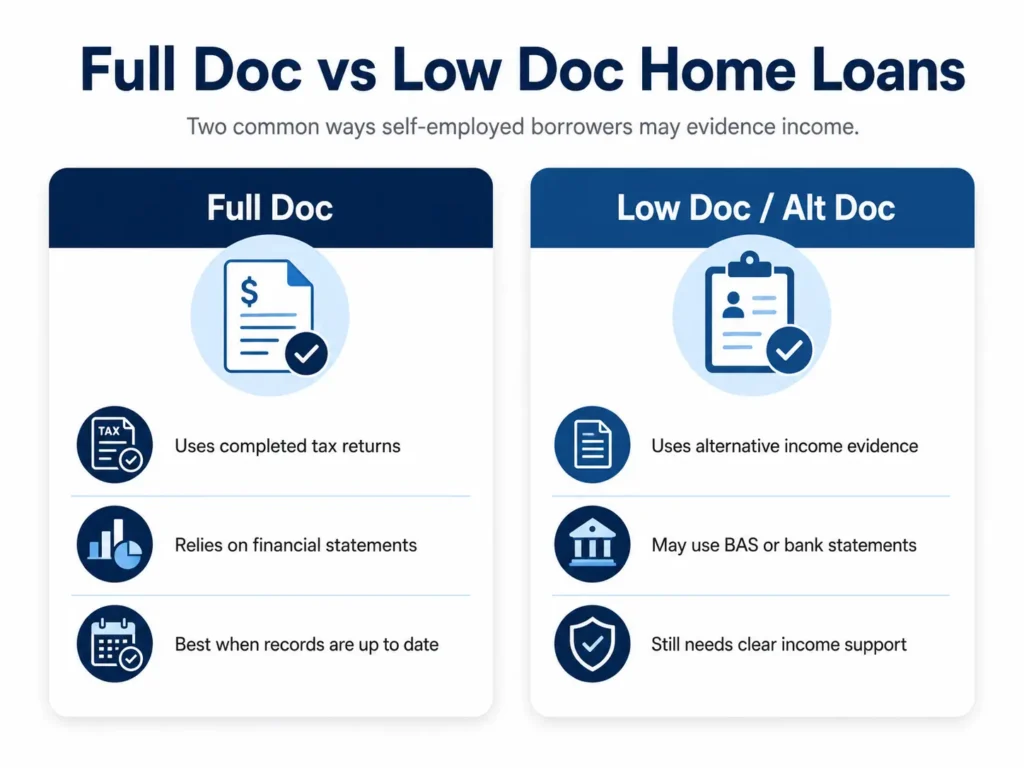
A full doc self-employed home loan usually relies on completed tax returns and financial statements. This may be suitable where the latest financials are strong and up to date.
A low doc or alt doc option – sometimes called low doc home loans – may be considered where the income is real but the latest tax returns are not complete. In these cases, lenders may use BAS, bank statements or accountant declarations.
Low doc does not mean no doc. The lender still needs enough evidence to verify income and assess risk.
Add-Backs and Business Expenses
Some business expenses may be added back when lenders assess income. These may include depreciation, interest, one-off costs, director wages or certain non-cash expenses, depending on the lender and the financial statements.
Add-backs can improve assessed income, but they are not treated the same by every lender. A strong application explains the income clearly rather than assuming the lender will interpret it favourably.
Company, Trust and Partnership Income
Self-employed borrowers often operate through companies, trusts or partnerships. This can create extra assessment layers.
A lender may review retained profits, distributions, director loans, company debts, beneficiary income or trust tax returns. The way income flows to the borrower matters.
This is where structure and lender fit are important. A good borrower may still be declined if the lender does not understand or accept the income structure.
Tax Debt and Self-Employed Borrowers
Tax debt and home loans can be a difficult mix, but approval is not always impossible.
The lender will consider the size of the debt, whether it is under arrangement, whether repayments are being made, and whether the borrower can meet both tax obligations and home loan repayments.
Unexplained or growing tax debt may be a concern. A clear explanation and repayment strategy can help.
Common Reasons Self-Employed Borrowers Are Declined
Common reasons include outdated financials, fluctuating income, tax debt, unclear business structure, insufficient deposit, weak bank conduct, high existing debts or choosing a lender that does not suit the scenario.
Some borrowers are declined not because they are poor applicants, but because the application was not matched to the right lender.
How to Prepare
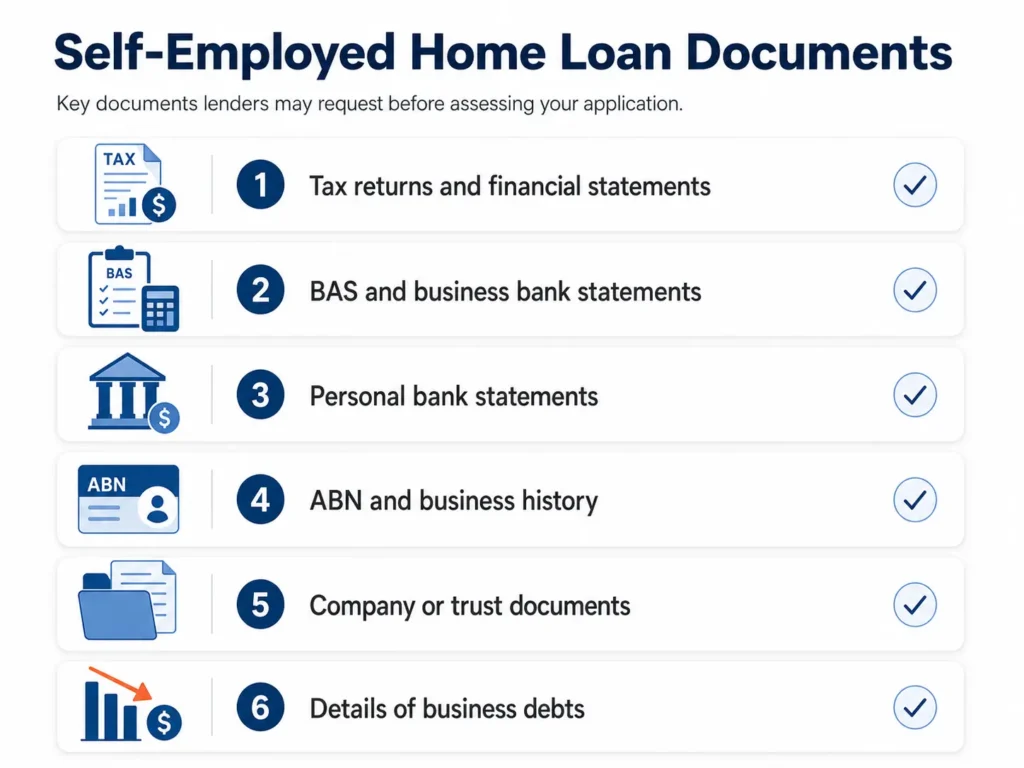
Before applying, gather key self employed home loan documents such as tax returns, financial statements, BAS, business bank statements, personal bank statements, company and trust documents, details of business debts and a clear explanation of income.
It also helps to review whether the latest year, average income or alternative income evidence gives the strongest and most accurate picture.
Conclusion
Self-employed home loans require careful preparation. The right lender, income evidence and application structure can make a significant difference.
At Evolve Lending & Finance, we help self-employed borrowers understand how lenders may assess their income, avoid dead-end applications and move forward with clearer strategy.
